World’s First 5G PNT Network Demonstrates Single-Digit-Meter Positioning Performance, Presented at ION GNSS+ 2026
At ION GNSS+ 2026, NextNav joined leaders across the Positioning, Navigation, and Timing (PNT) community exploring technologies designed to deliver reliable positioning and navigation when GPS signals are unavailable or compromised. As part of the conference session focused on Fielding Alternative Technologies in GNSS-Denied Environments, NextNav shared initial single-digit-meter positioning results from its 5G PNT Network in Santa Clara County, California, demonstrating how NextNav can deliver accurate, resilient positioning using standards-based 5G Positioning Reference Signals (PRS).
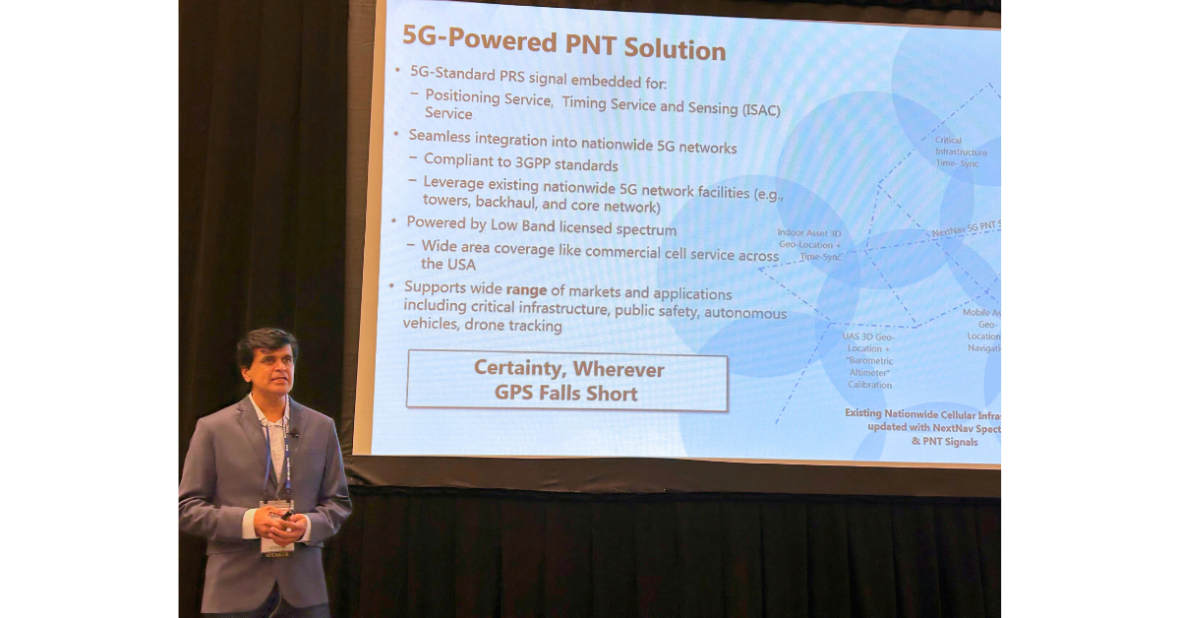
During the session, NextNav’s Sameet Deshpande presented results from NextNav’s live 5G PNT Network, examining the performance of 5G-powered positioning across real-world conditions.

The work addresses an increasingly important challenge: accurate PNT has become foundational to everything from public safety and critical infrastructure to autonomous systems and unmanned aircrafts, yet many of these applications remain heavily dependent on GPS.
“NextNav has spent nearly twenty years developing terrestrial PNT solutions,” said Deshpande. “The core mission has remained unchanged throughout that period: provide resilient PNT capabilities that can serve as both a complement and backup to GPS.”
NextNav’s approach is not to replace GPS, but to create a ground-based layer that can complement and back it up when satellite-based services are degraded or unavailable.
NextNav currently operates its 5G PNT Network in Santa Clara County. The network broadcasts 3GPP standards-based PRS signals alongside normal 5G data transmissions. PRS provides the structured signals needed for precise ranging and positioning, allowing a receiver to determine its location based on measurements from multiple terrestrial transmitters. NextNav’s licensed Lower 900 MHz spectrum provides propagation characteristics well suited for wide-area coverage and building penetration.
At ION GNSS+, Deshpande shared results from field testing across the 5G PNT Network in both outdoor and indoor environments, achieving single-digit-meter accuracy across indoor and outdoor and within 1-meter of GNSS (where GNSS were available)using 5G PRS transmitted from NextNav’s network.
These results provide real-world proof points for the scalability of terrestrial 5G PNT and its potential to provide resilient positioning across a wide range of environments.
The positioning results presented by Deshpande build on the initial timing performance NextNav demonstrated earlier this year at the ATIS Workshop on Synchronization and Timing Systems (WSTS). At WSTS, testing of the same 5G PNT Network demonstrated timing accuracy and stability of approximately 20 nanoseconds across real-world indoor, outdoor and GPS-denied environments. Those results showed how terrestrial 5G PRS can provide a resilient timing source for critical infrastructure applications.
The presentation at ION GNSS+ extends NextNav’s proven results to positioning, demonstrating the potential for the same standards-based terrestrial network to provide multiple components of resilient PNT. Together, these demonstrations move the conversation beyond whether terrestrial 5G can support PNT and toward how these capabilities can be deployed at scale.
“The future is a layered architecture where GPS and terrestrial systems work together to provide higher availability, better resilience and improved trustworthiness,” said Deshpande. “As critical infrastructure, autonomous systems and connected devices become increasingly dependent on PNT, resilience will become just as important as accuracy. We strongly believe 5G-powered PNT will play an important role in that future.”
As applications become increasingly dependent on accurate location and timing and concerns around GPS disruption continue to grow, resilient PNT will require diverse technologies capable of maintaining critical services when any single source becomes unavailable.
NextNav remains focused on demonstrating those capabilities in real-world environments and building a scalable, standards-based terrestrial complement and backup to GPS.