Results showed a time interval accuracy and time stability of approximately 20 nanoseconds, beating industry standards such as ITU PRTC Mask B.
NextNav was proud to share results from its 5G PNT Network operating in Santa Clara County, CA, at the recent Workshop on Synchronization and Timing Systems (WSTS), hosted by the Alliance for Telecommunications Industry Solutions (ATIS), joining a community of industry leaders who share a deep commitment to timing resilience and synchronization infrastructure.
During the session, “Integrating Terrestrial 5G PNT into Network Synchronization Architectures,” NextNav’s Distinguished Engineer Prasad Vajjhala and Igal Pinhasov, VP of Products at Oscilloquartz, presented joint lab and field work demonstrating how a terrestrial 5G network can serve as a resilient timing complement and backup to GPS for critical infrastructure applications. While GPS/GNSS remain foundational, increasing vulnerability, interference, and resilience concerns are creating a gap in current complementary positioning, navigation, and timing (CPNT) architectures.
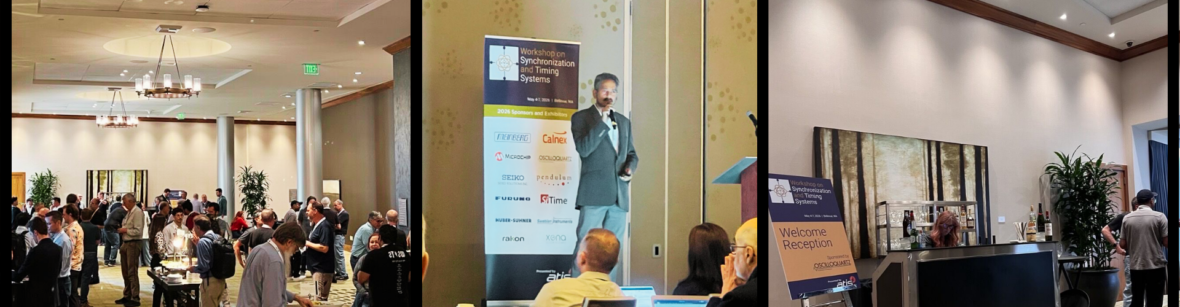
The team conducted testing over-the-air in both outdoor and indoor environments, including GPS-denied locations, leveraging NextNav’s operational 5G PNT Network. The demonstration highlighted how standards-based 5G Positioning Reference Signals (PRS) broadcast in the Lower 900 MHz band can provide resilient timing services that integrate into existing synchronization architectures, including those based on Oscilloquartz grandmaster clocks.
The joint demonstration showed how NextNav’s 5G PNT Network can support GPS-independent timing and synchronization requirements across industries that depend on resilient, precise timing, including electric utilities and AI data centers.
The results presented during the session showed that the system consistently achieved high levels of timing accuracy and stability, operating comfortably within the stringent performance limits defined by the ITU-T G8271.1 telecom timing standard.
“These results demonstrate that 5G-based PNT can meet the timing accuracy requirements of critical infrastructure applications in real-world conditions indoors, outdoors, and in GPS-denied environments,” said Vajjhala. “This is an important proof point for our industry.”
Pinhasov of Oscilloquartz added, “Resilient PNT is no longer about simply adding backup sources. It requires intelligent fusion of diverse, trusted timing inputs within a zero-trust architecture that can continuously validate, compare, and select the best source under changing conditions. At Oscilloquartz, we see terrestrial 5G PNT as an important new input to that architecture, complementing GNSS and helping operators build the next generation of trusted CPNT infrastructure.”
Beyond the core results presented, the session explored practical implementation lessons, including calibration requirements, timing receiver integration, and operational considerations for incorporating 5G-based PNT into synchronization networks. Field testing results from multiple outdoor and indoor locations showed timing output from a NextNav timing receiver connected to a timing grandmaster clock as an alternate time source, providing accurate and stable performance traceable to UTC time.
Broader themes throughout WSTS reinforced the increasing focus on timing resilience, particularly as governments, network operators, and critical infrastructure providers confront heightened concerns around GPS vulnerabilities, signal disruption, and infrastructure dependency. Keynote conversations further reinforced these themes. These discussions underscored the importance of complementary and resilient timing architectures capable of supporting essential services when GPS signals are degraded or unavailable.
As industries that depend on precise timing advance toward greater resiliency, NextNav is committed to demonstrating real-world results, building ecosystem partnerships, and delivering the standards-based solutions that critical infrastructure depends upon. We look forward to continuing that journey with Oscilloquartz and the broader timing community.